
Process
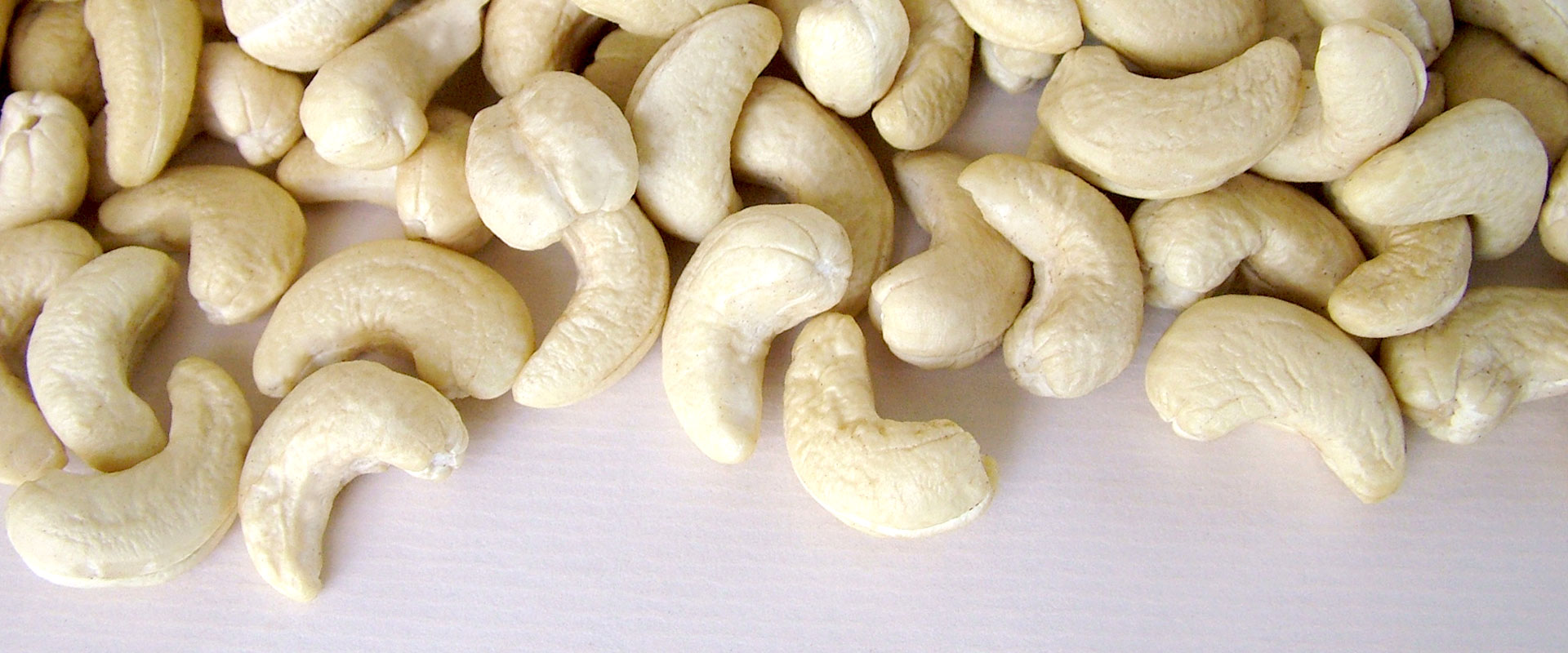
Modern cashew processing
Home / Process
PROCESSING OF CASHEW NUTS
India is the main cashew processing country in Asia. Since this is the labour intensive work during the preliminary stages, highly skilled work force around the nearby villages has been a boon for the company
The Process involved is as follows
Cleaning, sizing and conditioning
The first processing operation is the removal of foreign matter and dirt from the nuts. The nuts are collected from the ground after falling from the trees. Apples are removed along with other foreign matter. At the simplest level, the nuts can be sieved by hand using a three-quarter inch (20 mm) mesh sieve to remove dust and dirt. The cleaned nuts are then conditioned in preparation for removal of the shell. Conditioning increases the brittleness of the shell and thereby facilitates its removal.
Soaking or conditioning
The nuts are soaked in water in order to avoid scorching during the roasting operation. Conditioning is carried out in order to prepare for removal of the CSNL. In small-scale operations, after cleaning, the nuts are placed in a large open drum (180 to 220 litres/40 to 45 gallons). Water is poured into the drum and the nuts are allowed to stand for ten minutes prior to draining off the water through a hole in the base of the drum. The dampened nuts are then allowed to stand in order to absorb the adhering water. This soaking and conditioning operation is repeated up to three or four times until moisture content of nine percent is attained.
Roasting
Following conditioning, the nuts are prepared for the removal of shells. The application of heat to the nut releases the CNSL and makes the shell brittle, thus facilitating extraction of the kernel when breaking the shell open.
Drum roasting
An improvement on the open pan roaster was the development of a drum roaster, within which the cashew nuts are roasted. The drum is tilted at an angle over the fire and rotated during heating to prevent the nuts from burning. During rotation, nuts pass through the cylinder and out of the opposite end of the drum. The duration of the roasting process can be regulated by changing the speed of rotation of the drum. The cylinder is covered in a hood connected to which draws the black smoke upward into the atmosphere and makes it less unpleasant for the operator.
Shelling
The objective of shelling is to produce clean, whole kernels, which are free of cracks. Shelling has always been manually performed in India. India has therefore enjoyed a virtual monopoly of cashew processing for a long time. A mechanism is developed at 3M to remove shells from cashew nuts.
Peeling
At this stage, the testa is loosely attached to the kernel, although a few kernels may have already lost the testa during prior operations. Manual peeling is performed by gently rubbing with the fingers. Those parts still attached to the kernel are removed with the use of a bamboo knife. Approximately 10 to 12 kg of kernels can be peeled by one individual per day.
Separation
After shelling, shell pieces and kernels are separated and the unshelled nuts are returned to the shelling operation. Blowers and shakers are generally used to separate the lighter shell pieces from the kernels. Recovery of small pieces of kernel sticking to the shell poses the greatest problem. This is usually done manually from a conveyor belt used to carry all the sorted semi-shelled nuts.
Pre-grading
Pre-grading can be done before or after drying the kernels and may greatly reduce the work involved in final grading. Pre-grading can be done mechanically for large-scale processes, separating mainly the whole from the broken kernels and sometimes separating the different size groups of whole kernels.
Drying
The shelled kernel is covered with the testa, the removal of which is facilitated by drying the shelled kernel, to produce the blanched kernel. Drying causes shrinkage of the kernel, thereby allowing the testa to be easily removed either mechanically or by hand with a knife. Drying also protects the kernel from pest and fungal attack at this vulnerable stage. All processors dry the shelled kernels prior to peeling. The moisture content of the kernel is reduced from approximately six percent to three percent by drying. Artificial drying is used in our factory, which ensures efficient drying at fixed temperatures.
Peeling
AThe peeled kernels can be separated into different grades by the peeler. Normally, the kernels are separated into white wholes, scorched wholes, white pieces, scorched pieces, browns and refuse. Strict cleanliness in the peeling operation is observed, not only in the peeling room and its facilities, all personal are instructed to stick to the rules of cleanliness.
Grading
The grading operation is important since it is the last opportunity for quality control of the kernels. After the kernels are extracted from the shells, dried and peeled, they are graded for export according to size and condition. The grading system is known as the American Standard, which is also incorporated in the Indian Government export criteria. Kernels are categorized on the basis of colour and condition. Peeled cashew nuts are classified into between 11 and 24 grades.
Packing
The normal packaging used for the export of kernels is airtight cans of 11.34 kg (25 lbs) weight capacity. The packaging material are impermeable, since cashew kernels are subject to rancidity and go stale very quickly. The can will be familiar to most tropical countries as it is a replica of the four gallon kerosene or paraffin oil can..After filling and weighing, the cap should be soldered in preparation for the vita pack process. This consists of removing all the air from the can and substituting it with carbon dioxide (CO2). The advantages of packing cashew kernels in carbon dioxide are two-fold. Firstly, carbon dioxide will not support life so any infestation that may have been present is therefore arrested. Secondly, carbon dioxide is soluble in cashew oil and goes into solution as soon as the can is sealed.
- Address: Ground Floor, Super Bazar, Udupi 576101 Karnataka, INDIA
- Phone: +91 98451 02811
- Email: md@3mexports.in
Recent Posts

Cashew: Benefits
Cashews are a storehouse of energy and essential nutrients...
History of Cashew
The cashew tree, native to Brazil, was introduced to India...Tags
Copyright © 2023 www.3mexports.in | 3M Exports, India | All rights reserved | Disclaimer | Powered by Kedige India.